Category Archives: Uncategorized

COVID-19 Anthology is here!

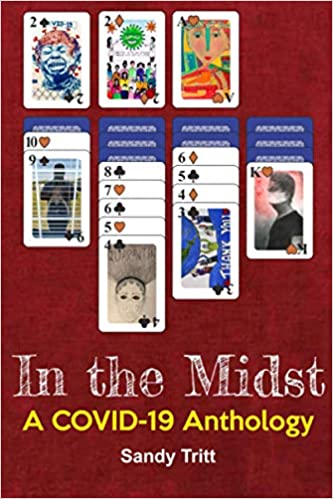
It’s here! I’m so excited to announce the release of In the Midst: A COVID-19 Anthology.

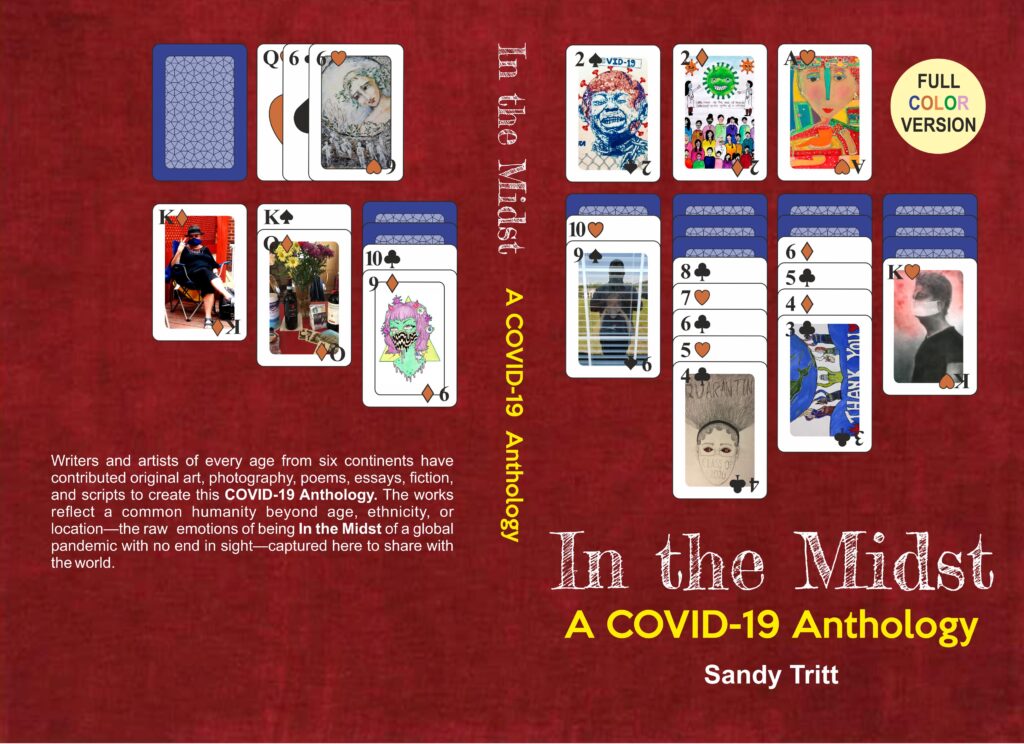
It’s been more than 8 months since a global pandemic shattered our world. Perhaps for the first time in history, people from every continent are experiencing the same emotions—fear, anger, sadness, anxiety. How are they coping? What are they learning? How have they changed? Writers and artists of every age (10-90) from six continents (including the countries of Argentina, Australia, Bangladesh, Canada, Ireland, New Zealand, South Africa, the United Kingdom, the United States, and Zimbabwe) have contributed original art, photography, poems, essays, fiction, and scripts to create In the Midst, a COVID-19 Anthology. The works reflect a common humanity beyond age, ethnicity, or location and are captured here to share with the world.

People are suffering in so many ways from this unprecedented situation. But the pages of this anthology carry much more than tears. They also show the resilience of the human spirit. Some offer encouragement. Some ways of coping—especially creative ways, such as taking up new hobbies. Others find humor in the quest for toilet paper, the mandate to “wash your hands,” and hair—from new hairdos and natural hair colors of those who can no longer see their hairdressers to COVID cuts for those who took the problem into their own hands. Some describe new skills or practices that have improved their lives—things they will retain long after the pandemic is over. And many show appreciation to the ones who’ve sacrificed to keep the world moving.

What ties them all together? The universal experience of living in isolation and anxiety during a global pandemic with no end in sight. People are in crisis and need to share their experiences and imaginative solutions.

Painstaking decisions were made to cut down the deluge of entries to this final selection of 100 pieces representing 84 authors and artists. I’ve always said that when you share your art or your writing, you share your soul. And we now celebrate the courageous people who have bared their souls to give you a glimpse into their lives.

I hope you are as touched as I have been by these honest, from-the-gut reactions while still IN THE MIDST of this historic pandemic. Hopefully, we’ll see our way out of this soon, and this anthology will become a collection to help future generations understand exactly what it was like to endure separation from friends and family, shutdowns of schools, churches, and “non-essential” businesses, and, of course, the fear and suffering caused by illness and death.   

In the Midst: A COVID-19 Anthology is available in two formats on Amazon. For a limited time, the standard edition with a black and white interior and will sell for $16.95 (if you are accessing outside the US, go to your regional Amazon website and put in “B08NX43Y4L” for the search number). The full-color version printed on high-quality paper sells for $52.00 (use search number “B08NX6Q2Q1”). The unique cover was designed and created by Lana Hunneyball. The art featured on the card faces are among the more than 30 original creations or photos included within the anthology. Lana used the layout of the card game “Patience” as a fitting representation of the patience required to get through this pandemic—and it’s a form of solitaire, which is especially fitting since many of us are alone at this time. Isolated.

But now you don’t need to be! Order a copy of this anthology for yourself and for everyone on your Christmas list. You’ll be glad to have the company.

And be sure to share this announcement on your social media pages.

Free promo eBook of A Consternation of Monsters

We here at Inspiration for Writers would like to alert our readers to a free eBook giveaway being conducted by one of our editors.  
Today through Friday January 15, the ebook of Eric Fritzius’ collection of modern fantasy short fiction, A Consternation of Monsters, is being given away FREE on Amazon.com’s Kindle.  

A consternation, as we all remember from grade school, is the collective noun for monsters.  It is therefore a fitting title for a collection of short stories which contain monsters of various sorts and shades.


In these tales, a creature of make-believe proves difficult to disbelieve, a trickster-god takes an unkindly interest in witnesses, eldritch horrors can be summoned using a quilt, frustrated wolves face dangerous prey, the angel of death wears a plaid sport coat, wise old women are to be feared and heeded, the corpses of legends can be perilous to have around, Elvis remains the once and future king of rock & roll, and where one of the most powerful and potentially destructive objects in the world is a fork.

You don’t have to possess a Kindle device to read this book.  If you have an iPad, tablet or even just your smart phone, your device’s app store will have a free Kindle app for download that will let you read this book as well as thousands of others (many of which can be found for free at such sites as FreeBooksy.com).  Worse comes to worse, you could read it on your laptop or desktop computer.

You can find your free copy of
A Consternation of Monsters at Amazon.com.
But hurry because this deal ends Friday at midnight.

Reviewers have said: 


“Fritzius invites the reader into worlds that don’t exist, or at least we think they don’t: Other planes of existence, multi-verses from where other creatures come to see us, monsters stepping out of the ether to do what they are designed to do — scare us and make us think about our the choices we make, what’s really important for us. Like survival.”

    — Cat Pleska, the WV Book Team at the Charleston Gazette newspaper

—–

“An entertaining and well-crafted collection of short stories offering mild horror, humour, and quirky ideas.”

    — Unlimited Book Reviews (ingeniouscat.co.uk)

—–

“It is my great pleasure to announce that Mr. Fritzius has delivered the goods with ten tales of the strange, weird, and delightfully dark. Like Bradbury before him, the author transports us across a wide variety of setting and tone, unveiling rich characters from all walks of life, with surprises waiting around every corner for them (and the giggling-through-fingers reader). An unqualified success.”

    — Aaron Christensen, horror movie blogger at Horror 101 with Dr. AC     

—–

“The reader is taken on adventures through the ancient, the mystical, and the powerful, delving into ideas of creation and destruction that most of us have not considered. All around us, ancient magic stirs and intersects with human life.”

    — Elizabeth Love, WriterBee’s Book Reviews (writerbeesbookreviews.wordpress.com)

—–

“A most absorbing read, this collection of monster themed short stories is fun, chilling, surprising, and utterly addictive.”

    — Jonathan Joy, WV Playwright

—–

“Collectively, Consternation operates to give us a nod and a wink about a much more sinister formulation of the Universe than mere angels and demons, which allows Fritzius the freedom to not lean on gore-n-scream horror tropes, but to play on familiar types and sub-genres in new, inventive, and entertaining ways.”

    — Joey Madia, New Mystics Reviews

—–

“I loved these not too gory monster stories. Plenty of scare, but not too much blood. Absolutely perfect.”

    — D. Lewis, Amazon.com

—–

A fine debut from a gifted storyteller.”

    — S.D. Smith, author of The Green Ember.

An Interview with Editor/Author Eric Fritzius

by
Eric Fritzus


IFW editor/webmaster Eric Fritzius has just released a collection of his short stories called A Consternation of Monsters.  It features ten of his short fantasy/horror stories each containing monsters of various sorts and stripes—a whole consternation of them, to use the collective noun.  Our editor/webmaster, coincidentally also named Eric Fritzius, sat down with Eric for an interview about the new book. 

1. Can you tell us a little more about your book, Eric?

I can indeed.  Thank you, Eric.  This is a collection of short horror and fantasy stories that I’ve written over the past twenty plus years.  I chose monsters as the unifying theme because that was kind of the common denominator between each of these stories.  There’s always something monstrous in them.  Sometimes the monsters are more traditional, as is the case of the famous Mothman of Point Pleasant, W.Va.  Got a dead one of those that turns up in “…to a Flame.”  The angel of death turns up a couple of times, too, usually wearing a plaid sport coat.  Other times, though, the monsters walk on two human feet, as is the case in “Wolves Among Stones at Dusk.”  And, in one story in particular, that also involves Elvis Presley, very much alive, well into the 21st century, the monster is a little more conceptual than physical, but devastating all the same.


2. What was the driving force behind writing this collection?

There was a driving force and her name is Belinda Anderson.  She’s my writing mentor, and the author of three collections of short stories (The Well Ain’t Dry Yet, The Bingo Cheaters, and Buckle Up, Buttercup) set in fictional Hope County, W.Va.  Through her writing workshops and classes, she’s been responsible for setting deadlines for and helping to shape a number of the stories that are found in this collection.  More importantly, though, she’s been after me to collect these stories for years.  And she finally had to set a deadline to get me to do it, which was for a local author event back in April.  Belinda also helped me edit all the stories and get them into final form, so I give a lot of credit to her.

3. What do you want your readers to take away from reading your book? 

Well, hopefully they’ll get a few chills from them, as many of the stories are in the horror genre.  But they should get laughs too.  Almost nothing I write is ever free of humor.  And these aren’t exactly intense horror stories to begin with–they’re more horror lite/modern fantasy stories, as these things go.  I’m not a big fan of the kind of gore and cruelty that the horror genre often showcases.  I’m more of a fan of stories in the style of Rod Serling’s Twilight Zone, which often contained terrifying concepts, but few stories that were reliant upon gore or things leaping out at you.

I hope they enjoy their time in my little world.  I like to take a page from Belinda Anderson’s books, again.  She sets many of her stories in the same fictional West Virginia county, and has characters who wander multiple stories across three books so far.  I’m also a big fan of world-building when it comes to writing fiction, so most of these stories are set within a basic shared universe.  It’s a fun method for writing stories that feel like they had a life before the reader arrived and the characters and events will continue on after the final page has passed.  A few of my characters carry over into other stories, too, sometimes even after they’ve died.  And there’s a character from one story who gets driven into a different story, locked in the trunk of a 1976 Lincoln.  Readers will have to follow the clues to figure out that mystery, though.

4. What writing projects are you working on now?

I’m working on some stories that will appear in future collections.  I have a number of short stories that have no fantasy/horror elements at all, which I would like to see them in their own collection.  But the ones I’m currently working on are genre stories, some of which are planned continuations of stories begun in A Consternation of Monsters.  I don’t want to say which ones, because that feels like a commitment to a sequel, but there are a couple of stories in this collection that leave their main characters in very interesting places.  The stories of those characters continue in my head already, so they really should in print as well.

5.  Speaking of less fantastical stories, while A Consternation of Monsters is your new collection, it’s not the only book you’ve had fiction published in this year.  And your other fiction appearance is not horror/fantasy.

Correctamundo!  I also had a short story published in the Diner Stories: Off the Menu anthology, published in March by Mountain State Press.  It’s a collection of writing–fiction, nonfiction, prose, poetry–on the subject of diners.  It was edited by Daniel McTaggart, who has an abiding love for the topic.  I contributed the opening story called “Flying Lessons Over Lunch, with Saint Joseph Cooper Tina.”  

6.  I take it there are not a lot of horror/fantasy stories found in Diner Stories: Off the Menu.

Actually, there are two stories with sci-fi/horror elements, and neither of them was written by me.  Toddy Ludy and Frank Larnerd have some great stories with horror/sci-fi elements in them.  However, while my contribution isn’t horror, it does feature two characters who also appear in A Consternation of Monsters.  See?  World-building.

7. Where can readers learn more about your book and your writing?

My website, MisterHerman.com is the best place to go.  I have a weekly blog there, where I write about each of the stories from the collection, telling how they came about.  I have also been adapting some of the stories into audio format.  However, unlike most audio books that simply have a narrator reading the material, I do that, but I also add music and sound effects.  It’s a little closer to a radio drama. 

I’m releasing these as the Consternation of Monsters Podcast.  You can listen to these adaptations right from my website or on iTunes, and they’re absolutely free.  It’s a good way to get a feel for the kind of stories that are in the book, in case readers would like a free sample. So far I have adapted “…to a Flame” and “Wolves Among Stones at Dusk.” 

I also have a Goodreads author page, an Amazon.com author page , and a Facebook page for A Consternation of Monsters.  My blogs are posted to each of those.  

As a bonus, Eric Fritzius is giving away a free copy of A Consternation of Monsters to one of you. All you have to do to qualify is leave a comment on this blog. Next Monday, a winner will be randomly selected and contacted by Jessica Nelson (in the form of a reply to his/her comment in this blog) with further information about how to collect his/her prize.

When a Woman’s Word Is Gold: How Women Are Redefining the Publishing World

by Daleen Berry 
(reprinted from Huffington Post)
If you’re a woman, this is your time: to get your book published, if you’re an aspiring author, or to find a good one to read, if you’re a bookworm. Or even to set trends, if you’re a publisher and you want to tell people about the great books you believe in.
I’m all four: a woman, a bookworm, an author, and a publisher. I self-published my memoir, Sister of Silence, in 2011 in paperback. The ebook came out in November. Even though the topic is dark, the message is not — and it’s one women can relate to. Namely that you have, at your own fingertips, the power to change your own life. Your destiny. Call it a book about women’s issues.
Which is why I went to the Women’s Fiction Festival in Matera, Italy, last week: it was chock full of women — who write books for women. The theme, “Publishing Is a Button,” was highlighted throughout the conference’s workshops. We learned about the digital revolution, where ebooks have overtaken paperback ones, and where indie publishers like Amazon are decimating traditional ones. We learned about the importance of agents, or how to go it alone (as I did) without one.
Most of all, we learned that the publishing world is now listening to women: We play a major role in such things as which titles get published and read, what a book will look like once it reaches the reader, and whether the media can stop a poorly-written book. (Fifty Shades of Grey proves it can’t, which is a great example of how the market — real readers, 80-percent of whom are women — is controlling what sells and what doesn’t.)
WFF’s founder Elizabeth Jennings is an author herself. “Finally it is changing in the favor of (women) writers. This is our time,” Jennings said.
“This is a fabulous time to be a writer,” Christine Witthohn, founder of Book Cents Literary Agency, said. “Two years ago, the prize was getting a contract with the Big Six (publishing houses) in New York. Not so much now. Indie presses offer better pay, advances and royalties,” Witthohn said.
Indeed, Witthohn has two debut authors who have earned a five- or six-figure income in a matter of months. One of those authors, S.G. Redling, sold more than 70,000 copies of her book,Flowertown, in the first six weeks.
Their publisher? Amazon. Wannabe authors take note: Amazon has CreateSpace, its publish-on-demand (POD) firm for self-published authors. Its Kindle Direct Program (KDP) produces digital books for indie authors and publishers. And now the giant online retailer produces its own line of books. Like Redling, those authors receive a traditional advance and royalties.
The publishing world is indeed changing. Nina Bruhns, an editor with Entangled Publishing, believes it’s due “in large part to the women authors who have worked so hard over the past 30, 40, 50 years, to show that we could write just as well as men” and that we have things to say that people care about. Bruhns believes this is because “we’ve finally reached the stage where we as women can write about things that are of interest to us and not be made fun of… but be valued for it.”
Publisher Stephane Marsan, head of the French firm Bragelonne, said the impact women are having on the market is amazing. In the U.K. a female editor or publisher will go to great lengths to convince everyone (in the business world who has a say) to publish a book. “Men think if we’re interested in it, we don’t think we have to convince anyone of anything,” Marsan said. “That’s a big mistake.”
In the past, publishing heads have been male, like Marsan. But women are fed up with having their books turned down, or at having to write more because of traditionally getting paid less than their male counterparts, Bruhns said.
Women are also disgusted when traditional publishing houses reject their books. I know firsthand what that’s like: I queried about three dozen agents and a few publishers before deciding to go solo. I formed Nellie Bly Books, LLC, and my little indie firm published my memoir. Now, a paperback book that I couldn’t get New York literary types to touch is being taught in four colleges or universities that I know of, including Johns Hopkins. The e-book is selling like hotcakes, and the 101 reviews have given Sister of Silence an average of 4.3 stars. It’s proving to be a book that speaks to women, but that didn’t matter to publishers.
And it never would have happened if I had not taken the reins and steered my horse in the direction I wanted it to go. Granted, I could have failed. But the facts show these new business models, largely run by women, are doing anything but.
Take Entangled, for instance. Bruhns said founder Elizabeth Pelletier opened her doors to huge controversy. Its business model is based on equality: shared profits and shared success. So everyone in the company (earns) royalties. It’s doing so well that Pelletier has had to condense her five-year plan into a one-year plan. “No one in their wildest dreams thought we were going to be this successful,” Bruhns added.
For women — who historically have been forced to live in a man’s world — the new publishing models are all about control. Until recently, female writers had absolutely none over their own careers. “From the first scribes back in ancient Egypt up until a few years ago, the writer was really at the bottom of the totem pole. Other people decided what we wrote, what got published, and what was available” for the public to read, Bruhns said.
“We had very, very little, if any, control over any of that process. Now that’s all changed. So our (time) has come and it’s just an amazing, amazing time to be a writer. Because you can decide yourself what you want to present to the world to read, and take care of your own career and not depend on somebody in New York or Milan or anywhere to make money or put out what’s best,” Bruhns said. “Not what you want. Or which won’t be available to read.”
Mary Leo, a romantic comedy author who once wrote for Harlequin but then found their doors closed to her, urged aspiring authors to “settle for more.” She did that when she went to a Romance Writers of America conference and teamed up with three other authors. They wrote one book, which they published through an indie press. The process was so much fun, the three authors published four more, similar books.
“All of a sudden I was able to write whatever I wanted to write, say whatever I wanted to say, because I knew we were going to publish them. They were going to find a home,” Leo said. “We started selling books and it did so much for my self-esteem. It brought back that creativity, that fun I had when I write,” Leo said. “It amazes me how easy it was. Suddenly I was having dinner with editors and agents.”
Author Janet Wellington has four traditional print books with publishers Dorchester, Berkley and Kensington. Nevertheless, she wanted to try the do-it-yourself route, which she calls “very doable.” Wellington said she learned in three months everything she needed to know to publisher her book, and then set up the digital edition with KDP.
The key to being a successful self-publishing author is the “responsibility of being professional,” Wellington said. “Make sure the book is edited and error-free, and your cover looks very good. All of that is extremely important because you are now your publisher if you’re indie.”
I can attest to that. Although I thought I had edited Sister of Silence until it was flawless, it turns out I was wrong. A few mistakes crept in. And trust me, that’s something readers notice — andcomment on in their reviews.
Unfortunately, there is a glut of poorly-edited or even badly-written books out there. This makes it harder for readers to find your book. But once they do, watch out. “For $200 you can pay for edits and your story shines through, so it’s worth it,” Anselm Aston, of Attica Books, a British indie publisher, said. “The challenge almost always involves getting people to find it,” he added.
Jennings says she believes the current abundance of books is great. “For readers, there’s been an intellectual boom,” she said.
The key is for readers to find a good, or even great book, by an author they love. “Always, always write a fabulous book and people will find you. Even in the glut,” Bruhns said.
Doing that may boil down to forming a psychological bond with other people — something women are famous for doing well. “The best weapon to make people buy a book is to talk about the human aspects of a book,” Marsan said.
He believes the real trick for today’s publishers is not just to find a wonderful book. Rather, it’s to find books that will make “a deep impact with the readers.” One that will achieve the ultimate goal of causing a reader to feel like they would like to have a chat with them, to know why the writer wrote the book, to “be their friend,” he added.
 
This Blogger’s Books fromAmazon
indiebound


Follow Daleen Berry on Twitter: www.twitter.com/DaleenBerry

Four Tips for Writing with Passion

by Nancy Parker


Writing seems like fun at first. I mean, what can be more fun than expressing yourself and sharing your interests and talent with the world, right? But, eventually, you may get bored. You are sick of being tethered to the computer, pouring out your heart with little to no reward. Or, worse yet, you are bored with your story. The same thing, day in and day out, and you are just burnt out. But what can you do? You don’t want to just stop and lose everything you’ve worked so long and hard for. Well, here are four ways to put the spark back in your writing life.

1. Take a break – Everyone gets burnt out. If you work on something, anything, for too long, no matter how fun it is, you will get tired of it. You can take a break. Sometimes, you have to. Now, that doesn’t mean that your story lies fallow, losing inspiration like rats off a sinking ship. There are other avenues. Take notes. Get into your character’s backgrounds. Heck, just draw pictures! Take a break from the long, draining bouts of writing and regain your passion.

2. Start afresh – No one ever said you couldn’t change things up. Maybe you have a story aboutromance. You are sick of romance. If you have to see one more shirtless dude you are going to puke. So, change it up. Start writing about mystery, for example. At first, tie it in with the romance. Things like a love triangle and a murder mystery would be a good start. Then as you go along, you can change the direction of your story completely and not lose all your hard work.

3. Pick something new – You’ve written the crud out of your story. You are just sick to death of writing essentially the same thing day in and day out. Here’s a hint: look at it a new way. If you’ve been writing from a male perspective, try writing from a female. If you’ve been writing as a senior, try writing as someone younger, or vice versa. If you come at things from a new way, you’ll see everything differently.

4. Fall in love – This can be literal or metaphorical. It is true what they say; that falling in love changes the way you see the world. Whether you have a new relationship in your life or just a new hobby, share the love. When you are passionate, it shows in your writing. It’s easier to write, things flow better, and it’s just more fun to read.

Don’t get so caught up in the business of writing that you forget your love for writing–the reason you started writing in the first place. Take a break, get some air, start a new hobby, and fall in love with your writing all over again.

Nancy Parker was a professional nanny and she loves to write about wide range of subjects like health, Parenting, Child Care, Babysitting, Live out nanny tips, etc. You can reach her @ nancy.parker015 @ gmail.com

Plot Basics

Plot Basics 

By Sandy Tritt

Before you can start writing, you must have at least a basic idea of the three major components of a story. Plot is what happens. Character is to whom it happens. And setting is where and when it happens. Most stories are either plot-driven or character-driven. A plot-driven novel is one in which what happens is more important than to whom it happens. An example of this is an action/adventure novel. A character-driven novel is one in which a character evolves during the story, and what happens isn’t as important as how the character reacts to what happens. An example of this is a romance novel. A successful plot must have a struggle of some sort—on one hand, something that a character (or characters) wants, and on the other hand, something that prevents the character from having it.


Plots are based upon three fundamental struggles:
• Man-against-man—this is when another character (the antagonist) is at odds with the protagonist (the main character) and tries to prevent the protagonist from accomplishing his goal. An example of this would be a cop chasing down a serial killer.
• Man-against-nature—this is when nature (or, possibly, machinery) causes problems for the protagonist. An example of this would be a man left behind in Antarctica, fighting for survival against the elements of nature. 
• Man-against-himself—this is when some character flaw within the protagonist prevents him from achieving his greatest desire. An example of this would be a man who wants a happy home life, but who battles alcoholism. 


Many novels have a main plot with several subplots spidering off of it. However, in order to keep a handle on things and to prevent random rambling, it is important to have a focus statement to give your story cohesiveness. A focus statement describes your story’s basic plot in one sentence. Yes. One sentence. Forcing this focus gives you a home base to return to and reflect from, and ensures that you don’t drift too much in other directions. 


Examples of a focus statement::
• An uneducated man from the slums climbs through the political world in his quest to become President. 
• A teenager hones his acting skills in hopes of making it big on the Silver Screen. 
• An alcoholic mother struggles to raise her children. 


A plot must also have three distinct parts: a beginning, a middle, and an end. The beginning, of course, is where the story starts. The setting must be firmly established (both place and time), the main character must be introduced, and the story question must be presented. The story question puts the focus statement into a “what if” format: 
• Will the uneducated man from the slums be able to achieve his goal to become President? 
• Can the teenager make it big on the Silver Screen? 
• Will the alcoholic mother be able to successfully raise her children? 


 The middle of the story is where we build the action and further develop the characters. The middle of the story is the link between the beginning and the end, and that which makes the end possible. The end of the story consists of two parts, the climax and the resolution, also called the denouement. The climax is the turning point in the novel, where the tension is highest. The climax is where all seems lost, where decisions must be made, where life and death hang on the balance. The climax should lead directly into the resolution, which should answer the story question and resolve the character statement of the main character (usually, these will be linked). 


In a character-driven novel, the main character should be changed in some way—wiser, more mature, kinder, perhaps even more cynical—but he/she must have undergone a change. If his character goal has not been achieved, then it must be resolved (perhaps the uneducated man from the slums decides that he can make a greater impact on society if he becomes a teacher than he could make as President or perhaps the teenager’s father is seriously injured in an accident and the youth realizes that nothing is more important than his family and he’d prefer to stay close to home). 


 Plot is accomplished through a series of scenes. A scene is the dramatization of one snapshot in time—what happens at one specific place at one specific time. Of course, the action may unwind over a period of several minutes or longer, but once the action is transferred to a different setting or to a different character, that scene ends and another scene begins. (However, the same scene continues if the viewpoint character himself is moving, say walking down the street from one house to another, or if the omniscient point of view is used). 


Every scene in a novel must further the plot or develop a character (preferably both at the same time); otherwise, it is an extraneous scene and should be cut. Every scene should also have a feeling of completeness about it. This is accomplished by ending the scene with an action, thought or dialogue by the viewpoint character, hopefully resolving or reviewing whatever “mini-crisis” the scene presented. 


Most writers divide their novel into chapters. Some give a title to each chapter; others just use numbers. There are no rules for assigning chapters, although I’ve read advice that suggests that each chapter should consist of three scenes or each chapter should consist of twenty pages. I think this is up to the individual writer. 


Plot is certainly one of the most important components in your novel. There are several ways to go about developing plot. Some people outline, putting every scene on an index card. Some people know the entire plot before they even write one word; others discover the plot as they write. If you’d like your own copy of our reproducible Chapter Summary Worksheet, which can help you outline your chapters, or the Novel Summary Worksheet, which can help you identify each component of your novel so you can stay focused, please just email me at sandytritt@gmail.com and I’ll send one out to you. 


Bottom line: plotting is as individual as personality. Find what works for you and use it. 


 Happy plotting! 


(c) 2003 Sandy Tritt. All Rights Reserved.

Chicken Soup for the Soul Submissions

Guess who is looking for submissions? Yep, Chicken Soup for the Soul. Contact them at
http://www.chickensoup.com/form.asp?cid=possible_books

Here’s what they say:

We’re looking for stories!

We have many Chicken Soup for the Soul® books in development and are adding new titles all of the time. We are always looking for new stories and poems and hope you have some for us to consider. Take a look at the list of our future book topics to see if you have a story or poem on a subject we are looking for and then please submit it to us.

If you have a great story or poem you want to submit but we are not collecting for that topic at this time, please save it and check back with us soon. Our list of Possible Books Topics is added to frequently and hopefully, in the near future, we will add a topic that will be a perfect fit for your story or poem.

We prefer that you submit your stories only once, but if you believe your story fits in more than one book topic, please indicate which other topics you have submitted it for in the Comments line on the submission form. You can submit your story by going to the link at the bottom of the page. Thanks!

Here Are Our Future Topics:

Independent Woman
Whether you are single or married, widowed, or divorced, you are in charge of your life and the lives of many other people. Tell us your story about running your independent life, achieving independence, and being a complete person. We are referring to all kinds of independence, not just financial or emotional. Share your story of empowerment and independence to help women of all ages feel stronger, more capable, and more confident. The deadline date for story and poem submissions is July 31, 2012

Inspiration for Writers
Whether you write fiction or nonfiction, books or articles, paranormal or romance, the process is equally challenging. Thus, it’s important to learn from others who have made the transition from dreaming about writing to being a writer. If this describes you, we want to hear about your setbacks, breakthroughs, and successes. How did you overcome writer’s block? Who or what encouraged you when you were about to give up? When did you realize that your story was ready to be shared with the world? This is your opportunity to help other writers — published and unpublished — draw inspiration and learn from your journey to publication (including self-publishing and blogging). The deadline date for story and poem submissions is June 30, 2012.

New Friends
Throughout our lives we meet new people and social circles change. Sometimes we have to say goodbye to friends and make new connections. We are looking for stories about men and women making new friends. Whether it was a move, a divorce, or a friendship that failed, share your stories about finding new friends. What led you to form new relationships? How did you go about it? This book will encourage and support other adults who are looking to expand their circle of friends. Funny stories are great too. We are not looking for teen or preteen stories for this book, just stories from people over 18. The deadline date for story and poem submissions is March 31, 2012.

Parenthood
They always say it’s the best job and the worst job. But basically it’s the best! We are looking for your stories about parenting – the hard work, the joy, the unconditional love, the funny times and the occasional sad ones too. Whether you’re a new parent of one or an “experienced” parent of several, by birth, by marriage, by adoption, or by fostering, tell us your stories about parenthood. Funny stories, stories that will make us tear up, stories with nuggets of great advice – all your anecdotes are welcome. The deadline date for story and poem submissions is June 30, 2012.

The Power of Positive
Everyone knows about the power of positive thinking. After the success of our book, Chicken Soup for the Soul: Think Positive, we are ready to make another book full of stories about how you changed your life, solved a problem, or overcame a challenge through a positive attitude, counting your blessings, or an epiphany of some kind. Tell us your success story about using the power of positive! The deadline date for story and poem submissions is April 30, 2012

Thank you!

SO, GET WRITING!

A Slice of Writer’s Life: Submissions News

Joy E. Held
Editor
Submissions Manager

The indie publisher is gaining traction in our business, and that’s good news for authors! Look at these indie publishers actively seeking submissions at the moment.

1. Martin Sisters Publishing is relatively new and open to non-fiction and fiction inspirational and Christian writing.

http://www.martinsisterspublishing.com/ Click on Aspiring Authors.

***

2. Secret Cravings Publishing is open to submissions for a new series called “Love On A Plane”. As long as the story includes a plane (or air travel of some kind) and a happily-ever-after-ending, they want to see your manuscript. Any time period, any length.

http://www.secretcravingspublishing.com/

***

3. Surely you’ve heard that e-monster Amazon is now in the publishing business, and we’re not talking about their self-publishing avenue. In fact, there are six new lines at Amazon Publishing covering a wide range of genres.

http://www.amazon.com/amazonpublishing

The newest Amazon genre is romance:

montlake-submissions@amazon.com

Would you like assistance with your submissions? Talk to me! We have several options and very reasonable rates.

Joy@Inspirationforwriters.com

Meanwhile, don’t forget to check out my book available online and from Who Dares Wins Publishing http://www.whodareswinspublishing.com/

I will be in Huntington, West Virginia Monday, April 23 as a featured author at the Ohio River Festival of Books 2012.

http://www.ohioriverbooks.org/

If your Huntington area group would like a workshop or book discussion with yours-truly while I’m in the neighborhood, contact me soon.

I will be in Cincinnati, Ohio June 1-2 as a featured editor at the Lori Foster Reader and Author Get Together.

http://www.lorifoster.com/

If your Cincinnati area group would like to schedule a workshop or book discussion while I’m in the neighborhood, contact me soon.

Be well, write well,

Joy

http://www.joyeheld.com/

http://writerwellness.wordpress.com/

“Women with clean houses do not have finished books.” ~Joy E. Held

A Slice of Writer’s Life: Platform, Product, and Promotion

“Platform, Product, and Promotion”
By Joy E. Held
PLATFORM, PRODUCT, AND PROMOTION. Write these three words on a slip of paper and tape them to your forehead. Okay, tape them somewhere around your writing space so they will always be on your mind. Why? Because we write to connect, and these three words should serve as your launching pad for everything you think, write, and do as a writer.
Platform is your message, the reason you write. Yes, even fiction writers have a purpose for writing their stories. Platform isn’t only for non-fiction writers. It’s all about connecting with readers, and platform provides a reliable jumping off point regardless of genre. It helps identify not only the story basis and background, but it helps writers find those specific readers who will most enjoy your story. For example, if you write sweet contemporary romance (which is your product, by the way,) you wouldn’t search for readers, reviewers, or publishers whose main interest is paranormal urban fiction. Having platform guides you to like-minded souls who will appreciate and support your work.
Product is obviously the book(s) you write and publish. But product expands beyond just your books. It includes a website devoted to your product(s), a blog where you connect and conceive with your ideas on issues, and the opportunities you have to promote your writing such as presenting at writer’s conferences or speaking to local groups, i.e., public speaking. And this ties you into the promotions aspect of the package.
Promotions are non-stop for writers and include regular “get the word out” efforts in your blog, speaking engagements, newsletters, direct snail mail campaigns, and bookmarks to name a few. The idea is to have a cohesive approach and appearance and you need platform, product, and promotion to be a writer in the fast paced world of contemporary publishing.
How do you start? With your writing, of course, but from there try writing out a one or two sentence statement about why you write what you write. This is your platform. Work diligently on your manuscript(s) and get a website and blog up and running or back in gear if you’ve already created them and let them slide. This is your product. Last, stay active in the world of writing and publishing by blogging on a regular schedule (whatever you can manage, anything is better than nothing,) attending writing events (at least one per year,) and spending whatever your tiny budget will allow on promotional materials such as business cards. This is your promotion.
For a website/blog, try blogger (this host) or wordpress.
For business cards and post cards try Vista Print.
Would love to hear your thoughts on platform, product, and promotion. If you can see around the piece of paper taped on your forehead, please tell me about the ideas you’ve tried.

Many thanks to the concepts of authors Bob Mayer, Jen Talty, and Kristen Lamb.

Be well, write well,
Joy

Writer Wellness, A Writer’s Path to Health and Creativity

Copyright 2012 Joy E. Held