Category Archives: a writer’s life

Writer Cocktail

by
Charlotte Firbank-King

Writers are a cocktail of madness. We’re psychotic, bent on killing those we love with as much impunity as those we hate. We wallow in death, misery, and general mayhem. Couple that with being pathological liars and master manipulators, then top it off with a dash of perpetual fried-brain and, oh, did I mention that we also have scant regard for laws and rules—of the English language or of social etiquette, that is. We fabricate words and foist them on unsuspecting readers who can’t even refer to a dictionary or Google to find out what the words mean. So that also makes us narcissistic deceivers. But we really don’t care as long as what we write is believable—and even that isn’t a given—we don’t care if it isn’t believable, because we will turn the reader into a believer.

Writers are a lone species of Homo sapiens. Okay, maybe we aren’t actually human.

Alice was an amateur when it comes to disappearing down rabbit holes. We probably shouldn’t marry and should definitely be neutered. The truth is, there’s no room in a writer’s life for anything except the characters we live through vicariously. But we gird our loins and periodically return to real-life like a meteorite hitting Earth. Our family will re-introduce themselves as we try not to call them by our characters’ names or warn them of some impending disaster that’s about to ruin their lives—note to self—that’s your daughter, idiot, not the character.

When we’re on a roll, we writers have this odd habit of ignoring dress code. We leap out of bed with ideas fermenting in our deranged, but very fertile brains, and head for the laptop or pen and paper. The only thing we may do en route is switch on the coffee machine. Five hours later, we’re surrounded by books, along with empty and full coffee cups ranging from cold to hot, and we’re still in our pajamas. We happily beat away on the PC, birthing new characters or killing off others in the most inventive ways. We transport ourselves to a thousand years back or a thousand years ahead. We go to countries and planets never heard of—we live in the realm of the impossible made possible through words. Sigh. What a divine place we live in.

Writers will discuss their characters as if they are real, and to us, they very much are. A conversation between writers could go like this:

Writer 1: “I don’t know what to do about Joe. He wants to head the narc operation, but he’s not ready and he’s too weak.”

Writer 2 understands completely and gives a sage nod: “I agree, he’s spineless. Kill him off.”

Writer 1 runs fingers distractedly through tousled hair and bites lip: “He wasn’t supposed to be a wimp—he’s the damn hero.”

Writer 2 sighs: “I know. It’s a pain in the arse when they won’t behave. My Mary was supposed to be the wilting damsel in distress, and now the slag is taking control. I might have to shoot her. I tried to get Mark to do it, but he’s not cooperating because the stupid sod thinks he’s in love with her.”

If non-writers happen to overhear this rather bizarre conversation, they may think they’ve landed in some sort of twilight zone. And they have—that’s where writers live.

Writers have long since learned to ignore certain responses to questions people ask. Usually starting with, “What do you do?”

“I write.”

“Wow, I’ve never met a writer.” Their brow furrows as they process the information. “Is that a real job?”

“Eh? It isn’t a job!”

“Oh.” Eyebrows rise. “Then how do you make a living?”

“What? Damn, dude, that question is so not relevant.”

Confusion reigns. “Not relevant?”

The person will get a long, direct look as we size them up—how will they fit into the next novel? That one predatory look usually has them backing off nervously, especially when you mutter that they would be a good fit for the villain you need to kill off in the next book. Some people don’t back down, but rush in and tell us about their lives or a friend’s life. Perfect. Absolutely perfect.

People need to understand that writers don’t operate in the same realm as say, a stockbroker, but we sure can write about one.

If one unobtrusively observes a writer, one may see them making faces or speaking to themselves in odd voices. Even getting themselves into weird physical positions. Writers are known for doing crazy things like crawling into a snake pit just to see how it feels—maybe that’s a little extreme, but they may sit at the bottom of a pool to see what it’s like to drown. Writers will certainly cut themselves to see what blood tastes or smells like. All experiments are toward one end—instilling realism into a story.

If you find a person watching you intently at an airport, shopping mall, or any public place, it may not be a psychotic stalker—not that there’s much difference—but it’s probably a writer, especially if he is making notes on any available scrap of paper. Cause a scene and make his day.

Writers will buy books worth hundreds of dollars for one paragraph of information. The books will probably sit on a shelf for the rest of the writer’s life. We don’t part with books—ever, especially reference books. You’d have to kill us first.

The moral of this convoluted discourse is: don’t become a writer if you value your sanity.
Sharing Homemade Bread

by Rhonda white  


Reprinted with permission from:
SHARING HOMEMADE BREAD

Today is bread day.
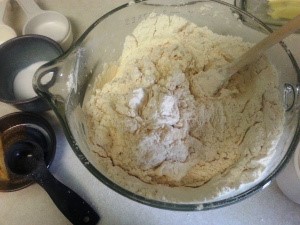
A few weeks ago, I succumbed to an urge that had been rising within me for a few months, and that was to make bread. Not just any bread, not bread from a boxed mix, and nothing that could be whipped up in a few minutes’ time, dumped into a bread machine, and popped out in a squarish loaf resembling an Amazon.com cardboard package. I wanted to make homemade sourdough bread; the kind that takes at least a week to prepare, the kind that must be fed and nurtured and allowed to rest, the kind created from—and by—living, breathing beings.

I should tell you that I killed my first starter.
There are certain, unbreakable, scientific laws that come with making homemade sourdough bread, and as ominous as that sounds, they’re actually quite simple to follow. That is, as long as you remember one of the most important rules, that being that you must stir your starter with a wooden spoon. Any contact with metal spoons (nickel, silver, aluminum, etc.) can introduce molecules that will kill the living microorganisms of yeasty sourdough starter. When feeding my sourdough starter the first time, you guessed it; I grabbed a metal spoon. Two days later, instead of the sweetly sour fragrance given off by healthy sourdough starter, mine reeked of rotting garbage, and the bubbles that occasionally rose to the surface had ceased. My starter had stopped breathing and died.
I’ve taken more care since then, and today as I stirred sugar, salt, oil, and flour into my starter and began kneading the dough, I thought of stories and of writing. Why is it that one creative act feeds another? I may never know the answer, but I’m always grateful for the inspirational nourishment. As I worked the dough, I recalled scripture from the King James Version of the Holy Bible: “And Jesus said unto them, I am the bread of life: he that cometh to me shall never hunger; and he that believeth on me shall never thirst” (John 6:35). 

I then thought of even older writings, one from the ancient Anglo-Saxon story of Beowulf, in which the bakers charge a share of grain to make and bake bread in communal ovens for the entire community. I was further inspired to look up a couple of quotes that I remembered from other poems and stories, wondering why these snippets have stuck with me for so long, choosing today to bubble to the surface:
“A Book of Verses underneath the Bough
A Jug of Wine, a Loaf of Bread–and Thou
Beside me singing in the Wilderness—
Oh, Wilderness were Paradise enow!” –The Rubaiyat of Omar Khayyam, 5th Ed.

And from more recent works:
“They swallowed the dark bread. It was like daylight under the fluorescent trays of light. They talked on into the early morning, the high, pale cast of light in the windows, and they did not think of leaving.” –Raymond Carver, from “A Small, Good Thing”
“The heat of the bread burned into my skin, but I clutched it tighter, clinging to life.” –Suzanne Collins, from The Hunger Games

You probably recall many other examples of bread used symbolically in literature. Why is it that writers often mention bread in their stories—aside from the obvious, that their characters must eat? Bread does more than simply feed the hungry protagonist; it serves as metaphor for deeper issues and hidden secrets in a story. Bread is sometimes used to represent life and health, or the lack thereof (as in stale bread, or moldy bread); it is used to represent plenty, as in the Biblical story of the loaves and fishes; it’s sometimes symbolic of comfort, family, and unity, as in To Kill a Mockingbird; and, in Hansel and Gretel, breadcrumbs are used to mark the way back home. It’s this last metaphor that I chose to use in my current work in progress, tentatively titled Romie & Jasper’s Big Empty:

“I stand on the back deck of the house, overlooking the acres and acres of grapevines, and I feel small, as if I’ve shrunk. I wonder if it’s true, if I have become smaller each time I’ve moved, if I left behind a broken-off piece of myself, like a trail of breadcrumbs, so I can someday find my way back to whatever place might be home.”
As I kneaded my bread this morning, it occurred to me how much making homemade sourdough bread is akin to writing. We put in the basic ingredients—our nouns and verbs and punctuation—and we let them rest. Days later, we return to the mixture, feed it with fresh words, stir them around, and let them breathe. After more respite, we keep a carefully measured portion, toss out what isn’t needed, and we add something sweet, something salty, and we work out the lumps and bubbles, ensuring that when we are done, it will rise and nourish all who taste it.
My sourdough recipe makes three loaves: one for today, one for later in the week, and one to share with friends. Sharing homemade bread—and memories and stories—with friends is my favorite part of the artistic process: it is the giving of one’s creativity, of one’s effort, of oneself, however noble or humble that gift may be.

“And he took bread, and gave thanks, and brake it, and gave unto them, saying, This is my body which is given for you: this do in remembrance of me.” Luke 22:19 (KJV)
© 2015. Rhonda Browning White. All Rights Reserved.
This has been reposted with permission from Rhonda’s blog, http://rhondabrowningwhite.com/2015/07/29/sharing-homemade-bread/