
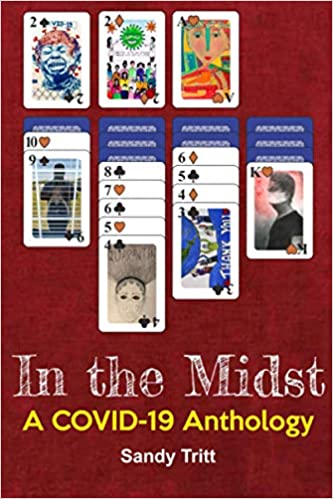
It’s here! I’m so excited to announce the release of In the Midst: A COVID-19 Anthology.
It’s been more than 8 months since a global pandemic shattered our world. Perhaps for the first time in history, people from every continent are experiencing the same emotions—fear, anger, sadness, anxiety. How are they coping? What are they learning? How have they changed? Writers and artists of every age (10-90) from six continents (including the countries of Argentina, Australia, Bangladesh, Canada, Ireland, New Zealand, South Africa, the United Kingdom, the United States, and Zimbabwe) have contributed original art, photography, poems, essays, fiction, and scripts to create In the Midst, a COVID-19 Anthology. The works reflect a common humanity beyond age, ethnicity, or location and are captured here to share with the world.
People are suffering in so many ways from this unprecedented situation. But the pages of this anthology carry much more than tears. They also show the resilience of the human spirit. Some offer encouragement. Some ways of coping—especially creative ways, such as taking up new hobbies. Others find humor in the quest for toilet paper, the mandate to “wash your hands,” and hair—from new hairdos and natural hair colors of those who can no longer see their hairdressers to COVID cuts for those who took the problem into their own hands. Some describe new skills or practices that have improved their lives—things they will retain long after the pandemic is over. And many show appreciation to the ones who’ve sacrificed to keep the world moving.
What ties them all together? The universal experience of living in isolation and anxiety during a global pandemic with no end in sight. People are in crisis and need to share their experiences and imaginative solutions.
Painstaking decisions were made to cut down the deluge of entries to this final selection of 100 pieces representing 84 authors and artists. I’ve always said that when you share your art or your writing, you share your soul. And we now celebrate the courageous people who have bared their souls to give you a glimpse into their lives.
I hope you are as touched as I have been by these honest, from-the-gut reactions while still IN THE MIDST of this historic pandemic. Hopefully, we’ll see our way out of this soon, and this anthology will become a collection to help future generations understand exactly what it was like to endure separation from friends and family, shutdowns of schools, churches, and “non-essential” businesses, and, of course, the fear and suffering caused by illness and death.
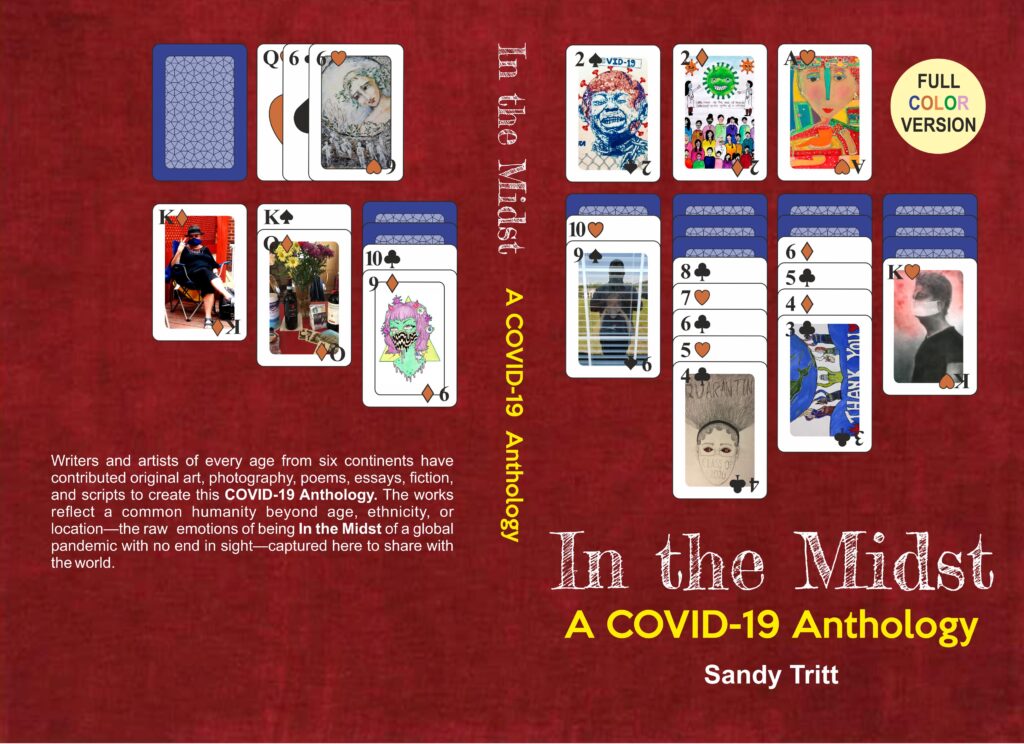
In the Midst: A COVID-19 Anthology is available in two formats on Amazon. For a limited time, the standard edition with a black and white interior and will sell for $16.95 (if you are accessing outside the US, go to your regional Amazon website and put in “B08NX43Y4L” for the search number). The full-color version printed on high-quality paper sells for $52.00 (use search number “B08NX6Q2Q1”). The unique cover was designed and created by Lana Hunneyball. The art featured on the card faces are among the more than 30 original creations or photos included within the anthology. Lana used the layout of the card game “Patience” as a fitting representation of the patience required to get through this pandemic—and it’s a form of solitaire, which is especially fitting since many of us are alone at this time. Isolated.
But now you don’t need to be! Order a copy of this anthology for yourself and for everyone on your Christmas list. You’ll be glad to have the company.
And be sure to share this announcement on your social media pages.