All posts by admin

Book Festival, NaNoWriMo, Oh My!


by
Sandy Tritt


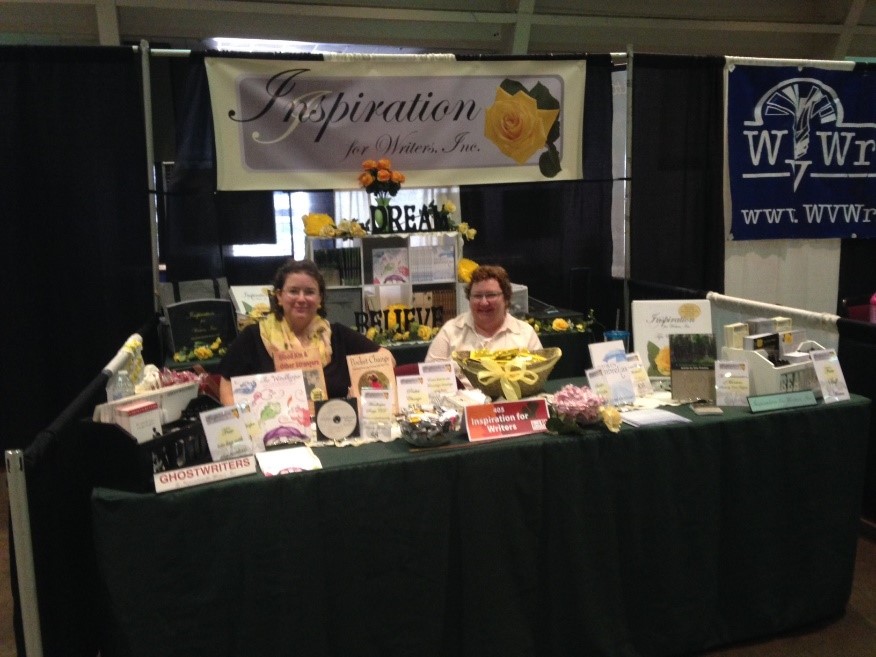
Who enjoyed the West Virginia Book Festival? We did, for sure. We—our team at Inspiration for Writers, Inc., which included author/editor Emma Broch Stuart, editor Jennifer Jett, editor Stacy Tritt, webmaster (and more) Eric Fritzius, grammar guru Wilma Acree, and I—loved meeting so many readers and writers. We talked and we gave away prizes and we talked some more.

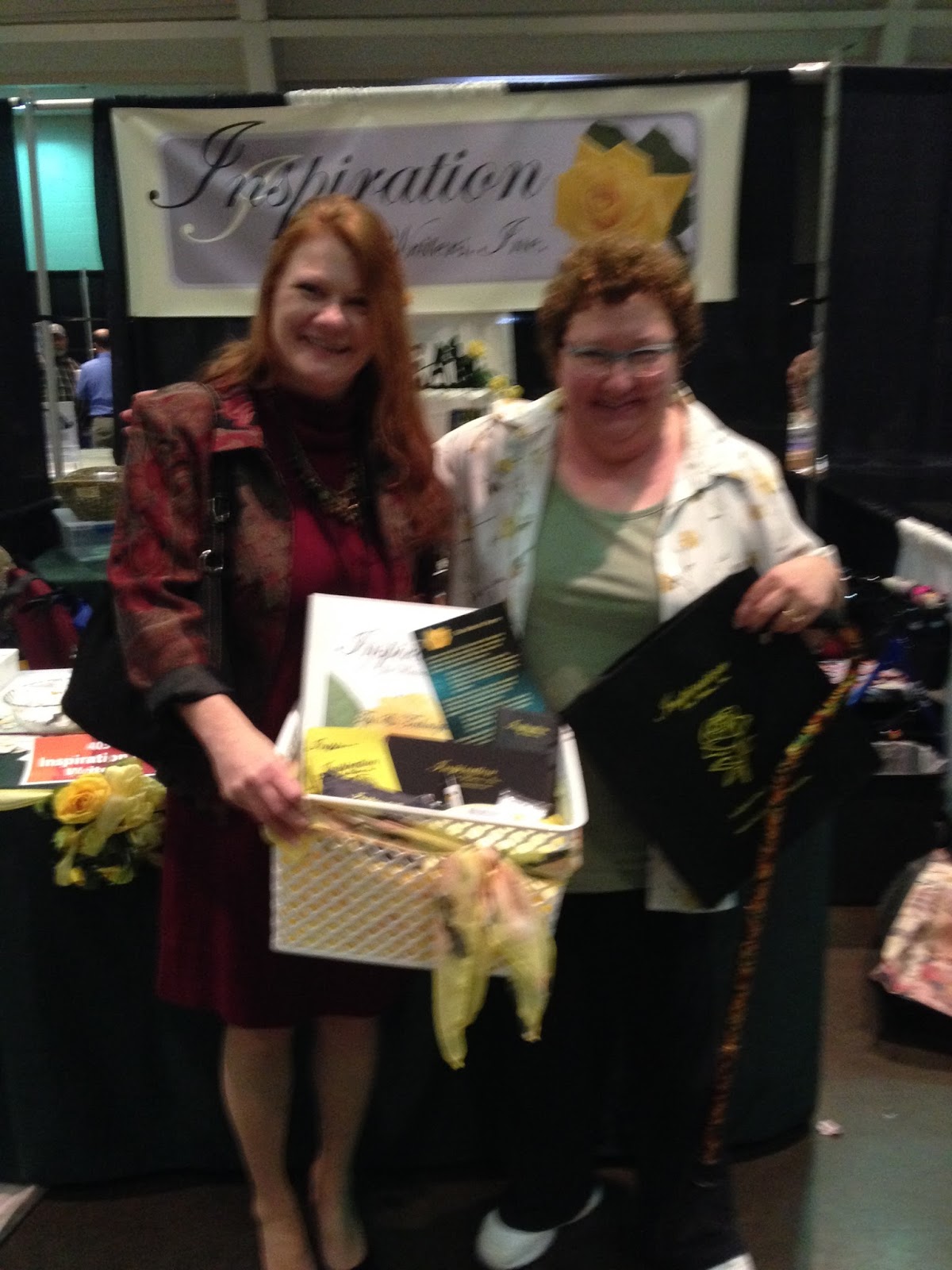
Rhonda Castle was the happy winner of the grand prize—a basket of lots of IFW goodies, including our brand new Tips and Techniques Workbook II and a gift certificate for $200.


Besides giving out lots of prizes, we had fun chatting with writers. In the next photo, Tom “Bond” chats with editor Jennifer Jett.
 
 
Check out our Facebook page for more photos and more winners. Sure hope you can join us next time.

Oh, and since November is going to arrive before our next blog article, we want to remind you that November is, as always, National Novel Writing Month (go to NaNoWriMo.org for more info). Karel Havel of Canada was kind enough to share with us his NaNoWriMo Excel chart that helps him organize and accomplish his goals. If you’d like a copy of this chart, just comment below or email me at IFWeditors@gmail.com.

If you went to the WV Book Festival, please let us know your thoughts in the comments below, and if you plan to participate in NaNoWriMo, please let us know that, too. We enjoy hearing from you!
 

Join Us at the WV Book Festival

by
Sandy Tritt

Exciting news for those of you in the West Virginia/Ohio/Kentucky area—the 2015 West Virginia Book Festival is back! An exciting line-up of authors includes Homer Hickman (October Sky, Rocket Boys), Neil Gaiman (American Gods, Coraline, The Graveyard Book), Jodi Picoult (Songs of the Humpback Whale, Harvesting the Heart, Picture Perfect, My Sister’s Keeper) and so many more. Go to http://www.wvbookfestival.org/ to see the line-up.

Inspiration for Writers, Inc., will have a booth at the festival, so if you’d like to meet some of our editors and staff, please be sure to stop by. We’ll be in the center aisle right next to West Virginia Writers, Inc. We have lots of freebies—pens, spiral notepads, whiteboards, sticky notepads, tote bags, Writing Wrongs cards, Comma Usage cards, glossy copies of “The Writer’s Prayer,” and more to share with our visitors, and some of our editors will bring books for sale. We will also debut our new, improved, 50% larger Inspiration for Writers’ Tips and Techniques Workbook. Oh, and door prizes. We’ll be giving away a special prize every hour, including a gift basket with a copy of our workbook, lots of goodies, and a gift certificate for $200 good toward any editing or writing service. But, mostly, we’d just love to chat with you and answer your writing questions in person.

Admission is free, and the festival will be in the Charleston Civic Center. Kickoff is Friday, October 23, 2015, with a writing workshop by authors Cat Pleska and Fran Simone from 10 a.m. until noon. The marketplace, where we will be, is open from 1–5 p.m. on Friday. On Saturday, October 24, the used book sale starts at 8 (be there early for the best bargains!) and the marketplace will be open from 9 a.m.-5 p.m.

The Charleston Civic Center is located at 200 Civic Center Drive in Charleston, WV 25301. For directions, go to http://www.charlestonwvciviccenter.com/directions.aspx.

We look forward to chatting with you. See you there!

Humbling Homonyms Part 1

by
Wilma Acree

As an avid reader, I sometimes chuckle and often cringe at errors I see in print. Just this morning, I cringed when I read this headline: 22 Dear Killed in North Hills Hunt. Yes, I am sure those deer were dear to others in their herd, but really!

If you are confused about dear/deer, make up some nonsensical rules to retain the meanings. For example, you might want to lean your ear against someone dear, but you would not do so to a wild animal (deer).

Other misuses I’ve encountered lately are shoo/shoe and waste/waist.

To shoo means to drive away. A shoe is something that covers your foot. Imagine my mental images when a writer wrote about “shoeing a fly.” An image of a fly wearing four tiny red shoes flitted across my mental screen. If only I could draw that . . . Alas, my artistic skills are nil.

If waste/waist gives you trouble, associate waste with the proverb: Haste makes waste. Or use the sentence: If I eat the food my children waste, my waist will increase. Imagine a thin person scraping plates over a waste can versus a person of increasing girth eating food from several plates.

Spell checkers or even grammar checkers will not catch homonym errors. You must rely upon your own brain, a language expert, or a trained editor. Better still, all three! None of us are infallible, but publishing a novel or even an article with homophone errors decreases your credibility and makes your reader wonder about your reliability.

Gawking Characters

by
Jessica Murphy

A “gawking character” is a narrator who tells the reader what happens in a scene instead of letting the reader experience it directly. This is called narrator intrusion, and it robs the reader of the full experience, thus distancing him from the story. A gawking character looks like this:

Gawking: Adam saw the orange glow and the rolling black smoke in the sky from where he stood on the corner of the block. As he jogged down the sidewalk toward it, he felt a cool breeze and smelled burning wood. He ducked under the branch of a tree and saw the burning house. From where he stood, he felt the intense heat and heard the flames roar and pop. Adam stepped forward toward the open front door but felt the searing heat from the sidewalk that drove him back.

The bold words show you where the narrator steps between the reader and the action and tells the reader what happens. This detracts from the reader’s experience. A scene must allow the reader to experience the action directly in order to grab him. Would you prefer to watch a friend eat a hot fudge sundae and tell you how sweet it tastes, or would you want to eat it yourself?

A gawking character is also redundant. If the scene is told from the character’s perspective, we already know that he experiences what we read. We don’t need to say the same thing twice. Here is the same sentence without the gawking character:

Direct: Adam glanced up from the corner of Kingwood and Beechurst. The starlit sky glowed orange, and thick smoke rolled across it. He spun on one heel, crunching grit on the sidewalk beneath his shoes, and ran down the street. The cool autumn breeze carried sparks and the smell the burning wood. As Adam brushed the branches of a tree out of his face, the burning house appeared.

A rushing roar filled Adam’s ears, and a wave of heat lifted the hairs on his tan arms. Shading his blue eyes with his right hand, he squinted against the blinding light. Flames engulfed every inch of the house and licked at the cloudless sky. Pops and crackles from inside the house echoed down the empty street. Adam rushed toward the front porch, but the heat seared his face and drove him back.

This time, the narrator does not water down the scene. We see no “Adam felt,” “Adam saw,” “Adam heard.” Instead, the reader is the one standing on the sidewalk, the one who sees the flames, feels their heat, hears their roar. This kind of direct experience captivates the reader and keeps him interested.

Nonphysical Gawking

A gawking character can also filter internal experiences, such as thoughts or emotions. Again, if the scene is being told from the character’s perspective, we can assume that any thoughts belong to that character (unless he or she can read thoughts or sense emotions).

Gawking: Blood soaked through the fabric, and Preston realized he had plunged the blade into Jack’s side.
This scene is told from Preston’s point of view, so he must be the one realizing something. We don’t need to state the obvious.

Direct: A red stain spread across Jack’s gut, matting the shirt to his skin. The silver blade glinted from where Preston had plunged it in Jack’s side.

The same holds true for emotions:

Gawking: I felt worried, but a breeze made me feel a little better.

This is told in first person point of view, so the narrator must be the one who felt worried. After all, he cannot feel another character’s emotions. So, stating what the narrator felt is redundant.

Direct: My stomach churned, but the crisp air cooled my feverish skin and the nausea settled for the moment.

If you take out the gawking character, the reader can experience every scene directly. Any less cheats him out of the story and, in the end, loses him.

Writing with Newborn Eyes

 
by
Sandy Tritt

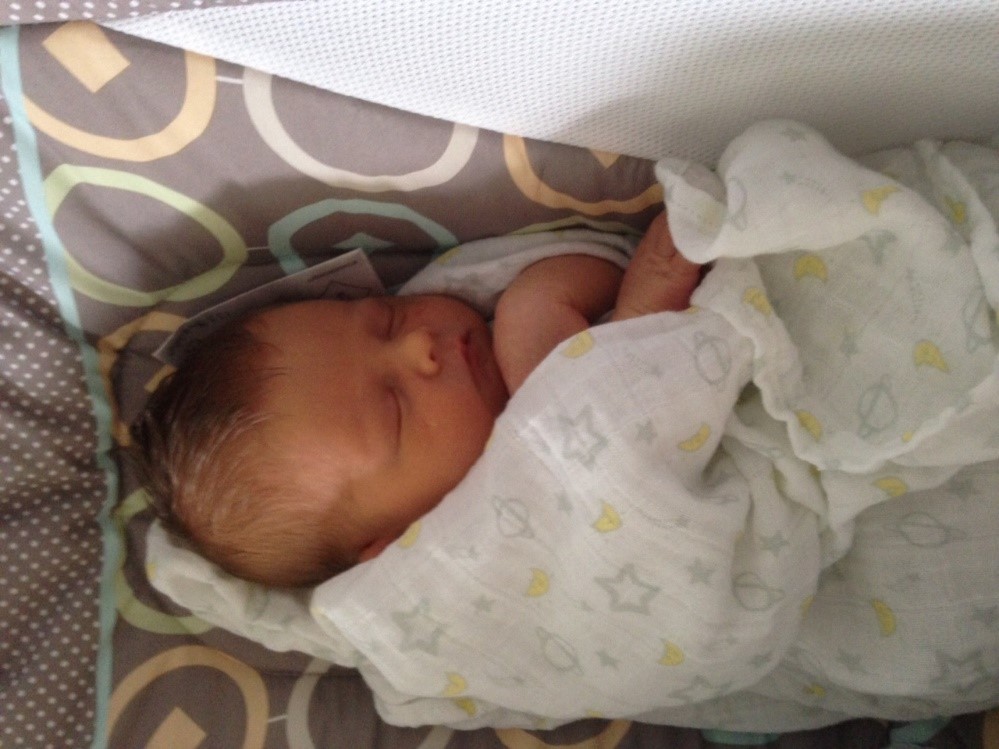
I was recently blessed with a new grandson. On his first day home, I took him around my daughter’s townhouse, showing him the sunbathing cats, dinner simmering on the stove, and the view from the patio doors. In doing so, I saw a few things I hadn’t noticed before. Like the way the geese rotated positions while paddling around the lake or the way Sam the Cat tilted his head to take in the spectacle of a tiny, squeaky person.

Cradling a newborn brought memories of my own babies. I remembered how surprised my daughter was when a light rain fell and tickled her nose. We lifted our faces to the sky and allowed the warm drops to trickle over our skin. On another day, she noticed spring buds bursting from the barren branches. We stopped and touched them, smelled them, explored them. I experienced my tired old world through new eyes.

Years ago, before the advent of GPS or cell phones, I was driving back to college. One of my classmates lived along the way, and I had offered her a ride. I followed her directions, yet when I got to where I thought she lived, I didn’t see her house. During my fourth pass, my friend ran out from between trees. I stopped, and it was then I noticed the red door of a house cut into the hillside, hidden by trees. When she was in the car, I asked why she hadn’t mentioned the house was cut into the hillside and hidden by trees. She looked surprised. “Well,” she said, “I guess I’ve lived there all my life and just never paid any attention.”

But that’s exactly what writers must do. We must pay attention to details. We’ve been told to “write what we know,” but sometimes “what we know” is too familiar. We don’t experience the buds and the rain—nor do we see the trees and hills. We take common smells, sights, sounds, tastes, and touches for granted—and we often do the same for the world we’ve created for our characters. To avoid doing this, we must learn to experience our surroundings with all our senses. Touch grass and notice the texture. Smell it. Taste it. Explore food. What type of smell does it have? Does it make any sounds?  How does it taste on first bite? After chewing? How does it feel to our tongues? Train yourself to notice the details of your everyday world so when you sit down to write, you can pull from those experiences and provide more insight into your characters’ worlds.

If you want to improve your writing, write through newborn eyes.

Guilty!

by
Charlotte Firbank-King


As a new or accomplished writer, what are you guilty of?

Are you guilty of being arrogant? Is your reader the enemy you’re writing at because you really need to put your brilliant prose on paper? Of course, ninety-nine point nine percent of readers are about as bright as an amoeba on a bad cell day, so your genius is totally wasted. But this is about you and your obsession to write. Right? —WRONG.

Are you guilty of being clever? You use words, scientific or otherwise, that have readers paging through a dictionary like a chipmunk on crack to understand what the heck you’re talking about. For example: Cavernulous – just say porous already. Otherwise, you’ve killed the flow and probably the reader’s enthusiasm to read your story.

Are you guilty of gimmick writing? You write everything in the present tense because it suits your literary genius. Or you exclude a word you hate from the entire manuscript, like that, said or had. I’m all for cutting down on these words, but sometimes they’re needed. Do you omit punctuation or new paragraphs, or remove dialogue all together and just narrate? It can work, but you have to be inventive to hold the reader’s interest. There are many versions of artifices that only stroke the author’s ego and cause the reader to tear out his hair. All you do is make the experience of reading your story uncomfortable. You put a barrier between the reader and the story until all they see is the author intruding into their pleasure of the story.

At the end of the day, you need to ask yourself if you value your reader. Do you really want your reader scratching his head, paging back to try to understand what you’re saying, or skipping paragraphs that are annoying? Is your aim to make him think about the deep meaning of your story, or to make your reader feel dense?

A reader may not remember all the details of a story, but he will always remember how you made him feel. Readers want to laugh, cry, hold their breaths, or sigh with relief. Are you guilty of not evoking any of these emotions?

Are you guilty of telling the reader a character is being funny or sarcastic? Like, writing, “she teased lightly,” or “his words dripped with sarcasm.” Make your writing speak with actions, emotions, and dialogue.

Are you guilty of swamping the reader with details that don’t add to the story or of repeating information in case he “didn’t get it” the first time round? Giving readers every detail of what characters are doing is tiresome. Readers are smart. They will fill in details like characters needing to put on shoes and a jacket and fetching an umbrella before going into a howling rain storm. It’s okay for them to just shrug into a jacket and go—have them flick open the umbrella as they walk out. In short, don’t make shopping lists of actions and don’t give readers every detail from the socks to the hat to the brushing of his teeth.

Are you guilty of not editing, editing, and editing multiple times before sending the manuscript to an editor or launching it on Amazon? Can you be sure there are no plot flaws, typos, or grammatical errors? Show respect for your reader—and editor, for that matter, and EDIT, over and over before releasing the manuscript.

Are you guilty of creating too many coincidences to make your plot work? Every action and scene that leads to the climax must be believable. If a character says, “I can’t believe that happened!” the reader will probably be thinking me neither. If it’s improbable, set it up ahead of time. She fell off the mountain and a piton caught her jacket, saving her. Show us the piton long before it catches on her jacket—set it up, make it feel probable.

Are you guilty of throwing readers constant curveballs, then leaving then hanging while you move on to another scene? You can get away with this once, but not in every chapter. They want to know if the gun fired at the character killed them or not—and they want to know in this chapter. They don’t want to wait three chapters to find out, while the second character is hanging from a cliff by their jacket in the next chapter. It’s all about seamless flow—making it a great reading experience.

Are you guilty of misleading the reader with a “hook” in the first paragraph of the first chapter that doesn’t fit the plot? Your story is a thriller and the lead characters are making out in a park while their children play on the swings. Sonny Jim disappears and a frantic hunt ensues. If your book is about kidnapping or some other dark plot about kids being snatched, then you have the right hook. But if these characters never again show up in the book and your story is actually about an affair at an office, you’ve got the wrong hook.

Readers are not reading the story to admire your literary genius—they want to be entertained. It’s all about them and what they want and need. After all, they PAID for the book.

Above all, clothe yourself in humility. Realize that as a writer you are nothing more than a servant applying your skill to please your master—the reader.

Picture a world where you’re surrounded by people who can’t read. Would you still write?

Some pearls of wisdom:

There is no such thing as a moral or an immoral book. Books are well written or badly written.

Oscar Wilde

It’s the rare writer who excels at all aspects of the craft. There are masterful stylists who, at bottom, have remarkably little to say. And there are vigorous thinkers whose sentences plod along like the lumbering steps of a draft horse.

 —Ralph Waldo Emerson

“He has never been known to use a word that might send a reader to the dictionary.”

William Faulkner (about Ernest Hemingway)


Prepositional Preponderance

by
Sandy Tritt


As writers and editors, we continually study the language and find ways, both new and old, to write better. One way we can make our writing sharper is to limit the number of prepositions we use. Now, that is not to say prepositions are bad. They are not. We need them. They often give us additional information such as where something takes place or how something happens. But what is bad is when a sentence is so full of prepositions that we need a road map to find our way through it.

First, it’s important to identify prepositions. Somewhere during the middle years of our education, we memorized a huge list of prepositions. To help jar that memory, here’s a short list of the more popular prepositions:

about
above 
across
after
around
as
at
before
beside
between
by
concerning
down
during 
except
for
from
in
into
like
near
of
off
on
over
since 
than
through
to
toward
under
until
up
upon
with
within

For a full list, you can visit one of the many websites devoted to this topic, such as https://www.englishclub.com/grammar/prepositions-list.htm or https://en.wikipedia.org/wiki/List_of_English_prepositions. Do be aware: just because a word appears on the list does not mean it is always a preposition. Some words (such as “but”) sometimes act like prepositions and sometimes act like a different part of speech, such as a conjunction. So, it’s important not to memorize the list, but to recognize prepositions because of the way they behave. How do they behave, you ask? They add information. They tell us where or when or how.

A prepositional phrase is a phrase that begins with a preposition and includes the added detail that follows it. The detail usually comes in the form of a noun, pronoun, or gerund. Sometimes an adjective or other modifier will modify the noun. So, a prepositional phrase looks like this: at the store; before the storm; until it rains; while the sun is shining.

So, let’s get to how using prepositions—or, more specifically, NOT using prepositions—can make your writing sharper. As an editor, we are trained to keep our eyes open for anything that sucks the power out of prose. If you’ve looked over the tip sheets available on our website, you’ll know we preach against the overuse of a lot of things—adjectives, adverbs, ellipses, em-dashes, exclamation marks, italics, unnecessary words, etc., etc. One thing—at least, as of this date—we haven’t complained about is the preponderance of prepositions. But recently I’ve noticed overuse of prepositions in both fiction and nonfiction. And overusing prepositions creates long, boring sentences. Take this one, for example:

I sat at the pool at Stacy’s house under the umbrella with red stripes with Sherry from Grantsville until the clock beneath the awning of the clubhouse showed dinnertime.

Yuck! Just for fun, how many prepositions can you find in that sentence? Go ahead and count them. Here’s what I found: at, at, under, with, with, from, until, beneath, of. Nine!

So, how can we write this better? First, we look for ownership. How many times did we use a prepositional phrase instead of using a possessive? I’m seeing three times. If the pool is at Stacy’s house, we can probably assume it’s Stacy’s pool. So, we can cut at Stacy’s house and make this Stacy’s pool. If we’re under the umbrella with red stripes, why can’t we just say the red-striped umbrella? Another preposition cut. And then there’s always that pesky of. Of is unnecessary when it’s used to show ownership, such as in this case. So, we can quickly ditch it by changing the awning of the clubhouse to the clubhouse awning. We’ve cut three prepositions and now have:

I sat at Stacy’s pool under the red-striped umbrella with Sherry from Grantsville until the clock beneath the clubhouse awning showed dinnertime.

Second, we look for unnecessary details. Does it matter where the clock is located? Unless this has something to do with the story, it most likely does not. What is important is the time the clock shows, not where the clock resides. So, let’s cut beneath the clubhouse awning (or the original, beneath the awning of the clubhouse). And, really, do we need to involve the clock at all? It’s only the time that matters, not the clock. So, let’s cut the clock. Does it matter where Sherry is from? This one is tough to tell when a sentence is pulled out of context. But, more than likely, we don’t need that information.

Our sentence now looks like this:

I sat at Stacy’s pool under the red-striped umbrella with Sherry until dinnertime.

That brings us down to four prepositions: at, under,with, until.

Can we do better? Of course! If we’re with Sherry, why don’t we say, Sherry and I?

Sherry and I sat at Stacy’s pool under the red-striped umbrella until dinnertime.

Those are about all the easy fixes, and we’re down to three prepositions. According to some style guides and other advisors of good writing, we should never have more than two prepositions in a sentence (count how many prepositions are in this sentence). So, let’s see if we can cut one more. Reading this sentence, the prepositional phrase that still bothers me the most is under the red-striped umbrella. The first thing we can do is consider if this is needed information or not. If not, we can simply cut it. But if we need this information, we’ll need to rearrange the sentence. Note that rearranging can result in sentences with stronger verbs—a side-effect we can celebrate.

The red-striped umbrella shaded the pool where Sherry and I sat until dinnertime.

Wow! We’ve come a long way from our awkward original sentence. I’d still like to play with it and be more creative like saying “until the dinner bell rang” or something, but without knowing the context, it’s difficult to do those things. Still, we have a more precise sentence that’s easier on the eyes, the ears, and the brain.

Our goal in life should not be to rid ourselves of every preposition. Prepositions are essential. They provide the details and specifics we need to make sense of information. However, overusing prepositions is a serious problem and one we need to fix. We need to make it a habit to count the prepositions in our awkward sentences—and then find ways to get rid of as many as we can.

As with anything, practicing is what makes us better at identifying and finding replacements. I challenge you to:

1.      Count the prepositions in the example sentence, and
2.      Reduce the prepositions.


Put your response in a comment below, and we’ll send a set of “Comma Usage” and “Writing Wrongs” tip cards to a random commenter.

Here’s the sentence to stretch your patience—er, I mean, your writing skills:

Susan went to the dentist by the name of “Will Hurt” to have her tooth with decay pulled with forceps for extraction after she had a shot of Novocaine to anesthetize her gums around the tooth with pain.

(Hint: chronological order is a good habit).

SPECIAL LOOK: Out of the Ashes

 by
Sandi Rog


Last week, Charl revealed some of her early and not-so-great writing. This week, Sandi Rog addresses the flip-side of that post by giving us an excerpt from her recently published book, Out of the Ashes. The following post is taken (with permission) from Sandi’s blog Dare to Dream. You can find the original post and complete first chapter here.
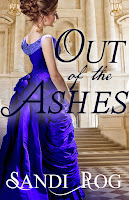
The book opens with a note to my readers:

Dear Readers:

Had it not been for the Lord and the many thousands of people who prayed me through cancer, this book never would have been written. If you’re one of the people who prayed for me, thank you. Mere words aren’t enough to express my gratitude.

Having emerged back onto the writing scene after the two-year battle, and feeling rather beat up after the long fight, I needed something with a happy ending. Like a fairytale. Think Cinderella. That’s what this book is, something bright and cheerful. So, Out of the Ashes is a lighter read than my other books: The Master’s Wall, Yahshua’s Bridge, and even Walks Alone.

What a blessing it has been for me to have the strength to write Nathaniel and Amelia’s story. Thank you, precious readers, for walking with me as I dig my way out of the aftermath of this battle one step at a time. Or shall I say, one page at a time.

Blessings,

Sandi Rog

Book Jacket Description

A stranger. A kiss. A shotgun wedding.

NATHANIEL WARD, wealthy entrepreneur, needs a wife. But he’s not interested in the preening, high-society women who are offered to him on a silver platter. He wants one woman, and one woman alone: the girl who gave him all the money in her reticule years ago when the Great Chicago Fire left him destitute. He sets out to find this woman and discovers she’s unattached. There’s only one problem, a shotgun wedding may be able to bind them, but will he ever be able to win her heart?

AMELIA E. TAYLOR blows a kiss to a street rat. Little did she know, years later that kiss would follow her to Green Pines, Colorado. When a handsome stranger arrives in her hometown, she guards her heart from the stirrings this man ignites. Despite society’s disapproval of spinsterhood, she is determined not to marry, having witnessed first-hand the lack of love and horrors that accompany marriage. But will a shotgun wedding reveal blessings that arise out of the ashes?

Chapter One

Green Pines, Colorado, 1882

Gun smoke burned Amelia’s eyes and her ears still rang. She blinked the tears from her lashes.

“Do you, Nathaniel Ward,” the preacher scowled, “take Amelia Taylor to be your lawfully wedded wife?”

Amelia’s father cocked his rifle and aimed it at the reluctant groom.

“I do,” Nathaniel said, his voice firm and unwavering. Despite her father’s threats, Nathaniel’s very presence exuded power, his raised chin, broad shoulders and wide chest unflinching against the barrel of the rifle.

Amelia didn’t dare look up at him. What must he be thinking? How many women had hoped to get him this far, and now, here she stood where most women dreamed of standing—shotgun wedding, or not. If only she could melt into the parlor’s wooden floor like the candle burning in the nearby lamp. Or disappear like the smoke. Disappear into nothingness, with no remnant left of her existence.

“Do you, Amelia Taylor, take Nathaniel Ward to be your lawfully wedded husband?” The preacher’s words rushed over Amelia like a gush of foul air.

She stood paralyzed, unable to speak. She’d vowed never to marry. How would she bear this cross? She’d seen enough loveless marriages in her life to know it wasn’t worth the heartache, despite the shame of spinsterhood. And now, to be forced on a man? What miseries awaited her? Abuse? Neglect? Slavery? Any man in his right mind would despise her for the rest of his days. It would be impossible—unthinkable—to procure his affection … his love.

The minister, still in his nightclothes, cleared his throat. His wife, holding up the lantern, glowered from behind him.

Amelia swallowed, darting a glance at her terrifying father. With a snarl, he narrowed his eyes at Nathaniel and pressed closer with his rifle. Would he put another hole in the preacher’s wall? Or Nathaniel’s chest?

“Amelia, girl.” Her father’s voice sent a shudder down her spine as it echoed through the quiet house. “You know, I always keep my word.” He’d threatened to kill Nathaniel if she refused to be his wife.

“I do,” she said, her voice small and trembling, quite the opposite of the man next to her. The horror, the shame. How did her life come to this?

“I now pronounce you man and wife.” The minister slammed his Bible shut and pointed it at her father. “Now get out!”

Shadows clouded Amelia’s vision, and her legs wobbled like those of a newborn calf. Her knees buckled, but rather than landing on the hard floor, she found herself caught in Nathaniel’s strong arms.

Now her husband.

You can find Out of the Ashes on Amazon and Sandi’s other works here.

Believe It or Not, Editors Aren’t Born Writers

by
Charlotte Firbank-King

A month ago—in South Africa, just to ground the reader—I had to pack up my house and studio in Port Elizabeth and relocate to Durban. In the process, I came across stuff I’d written when I was about eighteen. All the writing from my early teenage days must have been binned at some point, since, at eighteen, I was clearly past rubbish writing. I do recall being convinced that my romance novel, grandly titled, Inner Flame, was going to be a best seller—no question about that. One look at this title and you realize it doesn’t get much more purple than that. God help the poor soul who dares venture between those pages, but I can laugh at myself and did indeed go there. Let’s say it wasn’t really a venture, but rather a stumble over purple prose, a million adjectives and adverbs, and fat grammatical and spelling errors (no spellcheck back then). The head-hopping alone made my head spin.

Then I got married and nothing much happened because I was too busy breeding. I found more manuscripts, written when I was about thirty. I was clearly done with procreation, and I had a divorce under my belt. This second stab at writing was an improvement, but still no cigar for good writing.

The point of this trip into the past? Editors aren’t born writing with skill.

To be honest, if Inner Flame came across my desk now, I would probably send the writer every tutorial IFW has, including a thousand writing links on Google, and then tell them to go hide in a cave and learn to string at least one coherent sentence together before wasting their money on an editor.

Here are a few pearls from Inner Flame. I left the spelling errors in, even though MS Word kindly changed them for me. I must have been fixated on the size of the room, since I sure didn’t need full stops. This was all handwritten before I finally scored a wondrous typewriter.

Felicity walk down the wide stairs to the room below, it was a vast ball room hung extravigantly with chandeliers, the floor was glossy marble, Victorian furniture was arranged in it a large grand piano of oak stood at the far end of the room like a majestic queen of furniture, heavy curtains of deep red velvet adorned massive windows and french doors.

The chandeliers must have smiled from above to see this pink whisp of a girl almost float accross the huge room, she might have been a thistledown in a field for all she compared in size to the room.

Here is another gem:

Felicity was a long time in falling asleep, she lay between the soft linen sheets staring out of huge windows at the moon, clouds drifted like silver ships across her face, as round as a disc.

I could go on, but I would hate to hear a reader had died from laughing. The head-hopping examples of my eighteen year-old brilliance will take too much space, so I won’t bore you with those pearls of delight. You will just have to trust me that they’re there with oak-leaf clusters.

I now challenge our other editors to expose their badly-written-gems’ bellies to the public.

Surely, if we once wrote this poorly, there’s hope for you. If you need help bringing your writing up to the next level, email us at IFWeditors@gmail.com. Besides simply editing your work, we explain why we’ve made the suggestions we make so you learn as you go. Need even more help? We offer coaching, which is a personalized tutoring service that teaches you the things we’ve learned over the years. One client told us she learned more from one of our edits than an entire MFA program in creative writing. We’re here to help. All you have to do is ask. 

Sharing Homemade Bread

by Rhonda white  


Reprinted with permission from:
SHARING HOMEMADE BREAD

Today is bread day.
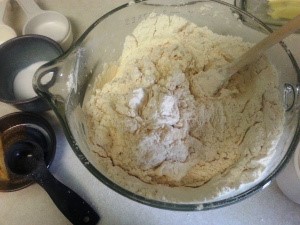
A few weeks ago, I succumbed to an urge that had been rising within me for a few months, and that was to make bread. Not just any bread, not bread from a boxed mix, and nothing that could be whipped up in a few minutes’ time, dumped into a bread machine, and popped out in a squarish loaf resembling an Amazon.com cardboard package. I wanted to make homemade sourdough bread; the kind that takes at least a week to prepare, the kind that must be fed and nurtured and allowed to rest, the kind created from—and by—living, breathing beings.

I should tell you that I killed my first starter.
There are certain, unbreakable, scientific laws that come with making homemade sourdough bread, and as ominous as that sounds, they’re actually quite simple to follow. That is, as long as you remember one of the most important rules, that being that you must stir your starter with a wooden spoon. Any contact with metal spoons (nickel, silver, aluminum, etc.) can introduce molecules that will kill the living microorganisms of yeasty sourdough starter. When feeding my sourdough starter the first time, you guessed it; I grabbed a metal spoon. Two days later, instead of the sweetly sour fragrance given off by healthy sourdough starter, mine reeked of rotting garbage, and the bubbles that occasionally rose to the surface had ceased. My starter had stopped breathing and died.
I’ve taken more care since then, and today as I stirred sugar, salt, oil, and flour into my starter and began kneading the dough, I thought of stories and of writing. Why is it that one creative act feeds another? I may never know the answer, but I’m always grateful for the inspirational nourishment. As I worked the dough, I recalled scripture from the King James Version of the Holy Bible: “And Jesus said unto them, I am the bread of life: he that cometh to me shall never hunger; and he that believeth on me shall never thirst” (John 6:35). 

I then thought of even older writings, one from the ancient Anglo-Saxon story of Beowulf, in which the bakers charge a share of grain to make and bake bread in communal ovens for the entire community. I was further inspired to look up a couple of quotes that I remembered from other poems and stories, wondering why these snippets have stuck with me for so long, choosing today to bubble to the surface:
“A Book of Verses underneath the Bough
A Jug of Wine, a Loaf of Bread–and Thou
Beside me singing in the Wilderness—
Oh, Wilderness were Paradise enow!” –The Rubaiyat of Omar Khayyam, 5th Ed.

And from more recent works:
“They swallowed the dark bread. It was like daylight under the fluorescent trays of light. They talked on into the early morning, the high, pale cast of light in the windows, and they did not think of leaving.” –Raymond Carver, from “A Small, Good Thing”
“The heat of the bread burned into my skin, but I clutched it tighter, clinging to life.” –Suzanne Collins, from The Hunger Games

You probably recall many other examples of bread used symbolically in literature. Why is it that writers often mention bread in their stories—aside from the obvious, that their characters must eat? Bread does more than simply feed the hungry protagonist; it serves as metaphor for deeper issues and hidden secrets in a story. Bread is sometimes used to represent life and health, or the lack thereof (as in stale bread, or moldy bread); it is used to represent plenty, as in the Biblical story of the loaves and fishes; it’s sometimes symbolic of comfort, family, and unity, as in To Kill a Mockingbird; and, in Hansel and Gretel, breadcrumbs are used to mark the way back home. It’s this last metaphor that I chose to use in my current work in progress, tentatively titled Romie & Jasper’s Big Empty:

“I stand on the back deck of the house, overlooking the acres and acres of grapevines, and I feel small, as if I’ve shrunk. I wonder if it’s true, if I have become smaller each time I’ve moved, if I left behind a broken-off piece of myself, like a trail of breadcrumbs, so I can someday find my way back to whatever place might be home.”
As I kneaded my bread this morning, it occurred to me how much making homemade sourdough bread is akin to writing. We put in the basic ingredients—our nouns and verbs and punctuation—and we let them rest. Days later, we return to the mixture, feed it with fresh words, stir them around, and let them breathe. After more respite, we keep a carefully measured portion, toss out what isn’t needed, and we add something sweet, something salty, and we work out the lumps and bubbles, ensuring that when we are done, it will rise and nourish all who taste it.
My sourdough recipe makes three loaves: one for today, one for later in the week, and one to share with friends. Sharing homemade bread—and memories and stories—with friends is my favorite part of the artistic process: it is the giving of one’s creativity, of one’s effort, of oneself, however noble or humble that gift may be.

“And he took bread, and gave thanks, and brake it, and gave unto them, saying, This is my body which is given for you: this do in remembrance of me.” Luke 22:19 (KJV)
© 2015. Rhonda Browning White. All Rights Reserved.
This has been reposted with permission from Rhonda’s blog, http://rhondabrowningwhite.com/2015/07/29/sharing-homemade-bread/